
Primary tabs
Urantiana
Posts
Urantiana webworks in full, latest on top
Page 4 of 13, posts 16 - 20 of 63
1.
D    C   A   Dm   G
I've got a   blue You book.
F                G
I wish You would take a look,
    F              Em
But only if You're int'rested
   Dm             C
In what it has to say
           Dm
Concerning what You ask about.
Em
You can look with honest doubt,
            F
But it will never help You out
   G
If You explain it all away.
2.
Am
You can never realize
G
What You won't internalize.
F
No surprise can come from
Em
Anything You read
Dm
You can argue and debate
Em
Never have to correlate
     F
Your life with what it has to state
         G
On human need.
3.
        Am
You can choose to worry, or
G
Choose not to worry anymore,
F
Listen to or just ignore
            Em
Your better side.
Dm
No one else will make Your choice.
Em
Only You can use Your voice
            F
For singing love or making noises
       G
Out of pride.
4.
Am
Give the words a second glance.
G
Don't be afraid to take a chance.
F
You might find You like to dance
           Em
Instead of sit.
Dm
But no one else can dance for You,
Em
Or move in quite the way You do.
        F
And the blue You book
     G
  is for the benefit
       F     G  C
    of You
Above is as performed in the video, differing slightly from the
previously published lyrics and rudimentary chord notations
previously published lyrics and rudimentary chord notations
Also performed in Mindful Webworkshop #4
•
•
•

•
•
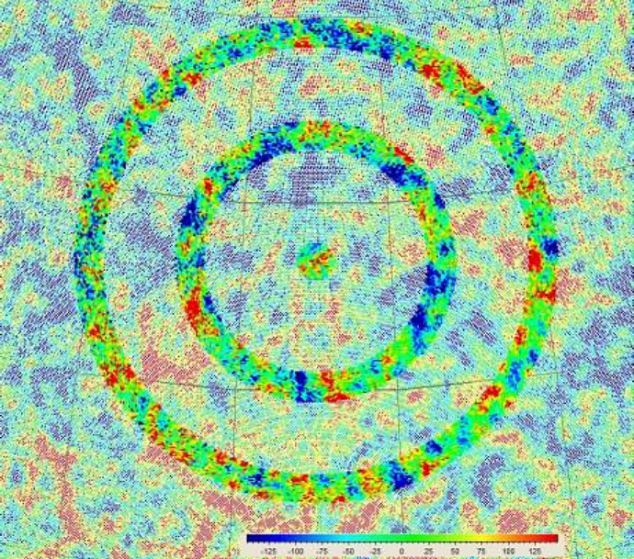
"Professor Roger Penrose from Oxford University says concentric circles discovered in the background microwaves of the universe … adds evidence to the theory that the universe has expanded ('the Big Bang') and contracted ('the Big Crunch') many times. … The research appears to cast aside the widely-held 'inflationary' theory of the origins of the universe, that it began with the Big Bang, and will continue to expand until a point in the future, when it will end. …
"They say that this means that … the universe cycles through aeons dominated by big bangs and supermassive black hole collisions. Professor Penrose believes that his new theory of ‘conformal cyclic cosmology' means that black holes will eventually consume all the matter in the universe. According to his theory, when they have finished, all that will be left in the universe will be energy - which will then trigger the next Big Bang - and the new aeon."
—Eddie Wrenn, Daily Mail (UK) [Emphasis added.]
How cheery! It's still The Big Bang + Big Crunch Theory, now it's just The Big Bang Theory in infinite re-runs.*
(I remember a late-night session at college in the early 1970s, possibly not even a chemically assisted session, where a housemate of mine [waving at Charlie] and I worked out that this could be a likely scenario. Didn't realize we were so ahead of our time.)
A Urantia Papers student might ask, might these rings also suggest a cosmic substantiation of "space respiration"? (In fact, it was a comment by "FizViz, Brighton UK," conjecturing just this possible association, which brought this to my attention.)
The cycles of space respiration extend in each phase for a little more than one billion Urantia years. During one phase the universes expand; during the next they contract. Pervaded space is now approaching the mid-point of the expanding phase…. For a billion years of Urantia time the space reservoirs contract while the master universe and the force activities of all horizontal space expand. It thus requires a little over two billion Urantia years to complete the entire expansion-contraction cycle.
Your own local creation (Nebadon) participates in this movement of universal outward expansion. The entire seven superuniverses participate in the two-billion-year cycles of space respiration along with the outer regions of the master universe. … When the universes expand and contract, the material masses in pervaded space alternately move against and with the pull of Paradise gravity.
The Mail article notes that the universe's age is estimated to be 13.7 billion years, "and they have discovered 12 examples of concentric circles, some of which have five rings - which means the same object has had five massive events in its history." I'm not sure that calculation was comprehensibly stated, but if five events were evenly divided into 13.7 billion years, that's about 2.75 billion years per cycle. Pretty close, considering with all the variables there's a galaxy-wide margin of error.
♥
Below the article, comments include this from one "Robert Tobin, Australia":
"Good bye 'God,' hello sense and logic and above all SCIENCE. … It was SCIENCE that made me Atheist even before I realised how stupid and illogical Religion is and how it spreads the Poison of the GOD VIRUS. THERE IS NO GOD, SO STOP WORRYING."
When I see this kind of remark, I usually think: "You know that the God you don't believe in? I wouldn't believe in him either." There is no logic in his anti-religious raving, no reasoning which draws a line between this scientific report and whatever problem he has with the concept of Deity. His remark sparked some responses, but I thought I would just contrast it here with this:
"Of the vast body of knowledge concerning the superuniverses, I can hope to tell you little, but there is operative throughout these realms a technique of intelligent control for both physical and spiritual forces, and the universal gravity presences there function in majestic power and perfect harmony."
—A Universal Censor, P15 §0 ¶3
So, yeah, stop worrying. He got that right.
Similarly-themed articles in Urantiana:
First People in the Americas
Anthropology & The Urantia Book on hominid evolution
Humanity's Lemur-Like Asian Ancestry
First People in the Americas
Anthropology & The Urantia Book on hominid evolution
Humanity's Lemur-Like Asian Ancestry
•
•
•
•
•

A mighty man in the kingdom, winning souls wherever he went.
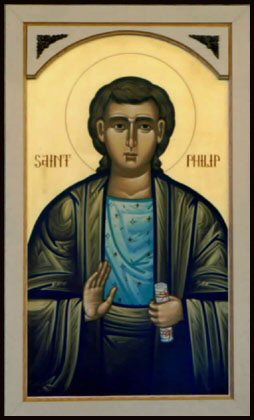
The tomb of St. Philip the Apostle, one of the original 12 disciples of Christianity's central figure Jesus Christ, has been discovered during the ongoing excavations in Turkey's south-western province of Denizli.
Italian professor Francesco D'Andria, the head of the excavation team at the Hierapolis ancient city in Denizli, told reporters on Tuesday that experts had reached the tomb of St. Philip whose name is mentioned in the Bible as one of the 12 Apostles of Jesus.
Professor D'Andria said archeologists had been working for years to find the tomb of the Biblical figure, and finally, they had managed to reach the monument while working on the ruins of a newly-unearthed church in Hierapolis.
D'Andria said the structure of the tomb and the writings on it proved that it belonged to St. Philip the Apostle, who is recognized as a martyr in the history of Christianity.
Philip went on through the trying times of the Master’s death, participated in the reorganization of the twelve, and was the first to go forth to win souls for the kingdom outside of the immediate Jewish ranks, being most successful in his work for the Samaritans and in all his subsequent labors in behalf of the gospel.
Philip’s wife, who was an efficient member of the women’s corps, became actively associated with her husband in his evangelistic work after their flight from the Jerusalem persecutions. His wife was a fearless woman. She stood at the foot of Philip’s cross encouraging him to proclaim the glad tidings even to his murderers, and when his strength failed, she began the recital of the story of salvation by faith in Jesus and was silenced only when the irate Jews rushed upon her and stoned her to death. Their eldest daughter, Leah, continued their work, later on becoming the renowned prophetess of Hierapolis.
Philip, the onetime steward of the twelve, was a mighty man in the kingdom, winning souls wherever he went; and he was finally crucified for his faith and buried at Hierapolis.
Through the influence of the Christian apostle Paul, a church was founded here while he was at Ephesus.[3] The Christian apostle Philip spent the last years of his life here.[4] In 80 CE, he was martyred by crucifixion and was buried here. His daughters remained active as prophetesses in the region.[citation needed] The Martyrium was built on the spot where Philip was crucified.
—Hierapolis (Wikipedia)
•
•
•
•
•
What's yawn-inducing or a head-scratcher to one person will be the Big Enlightenment to somebody else.
 Lucretius said, quod ali cibus est aliis fuat acre venenum!
As with reading the revelation. What's yawn-inducing or a head-scratcher to one person will be the Big Enlightenment to somebody else.
I sometimes think how, say, the deeper science passages in The Urantia Book would be so fascinating to those who might be well-versed in astronomy or physics but who are still looking for those scientific missing links that only revelation could supply. I'm not enough of a scientist to get that much.
Reading two weeks ago about the God concept among the Hebrews, Chris and I were both wishing we had better knowledge of history of Biblical times, but I'm sure some well-versed in history have appreciated the revelation's revelation of what really happened.
For some, the whole idea of the absonite might seem like gobbledygook, might be just as incomprehensible as twenty-seven point string theory is to me, but the way the Ultimate tied together the Supreme and Absolute was just what I needed theologically when I first started reading the UB.
That's where group study can be so helpful, getting to see other folks' perspectives on the various passages.
•
•
•
•
•
It was a little different than the average Christmas lawn display
Of all the many excellent revelations I've derived from the fifth epochal revelation, one stands out glaringly for me, from The Birth of Jesus.
 I mean, I figured out as a little kid the physics of "following the star" were impossible.
And I knew that he wasn't really born in a medieval European style shed.
And I knew that Christ-mass was just the church's way of co-opting the Roman orgy of Saturnalia, and wasn't ever claimed or supposed to be the day Jesus was born.
And I knew that he likely wasn't born 1 AD.
Bad Guy? Innkeeper wrongly accused, scholars say
Link corrected 2018 Dec 24
Link corrected 2018 Dec 24
And I had come to understand already that the innkeeper was historically inappropriately maligned — it was never his fault that Joseph didn't check with Travelocity beforehand — but the Urantia revelation added to my understanding of the innkeeper's exoneration. Now we can appreciate the innkeeper's business savvy, having the stables all cleaned up and converted to quarters for rent to the taxpaying crowds when they flooded into town, an event which, of course, had been well-advertised beforehand.
It was not that big a revelation to know there were no shepherds, wise men, Santa Claus, or Frosty the Snowman kneeling at the newborn's creche, as you see in lawn displays around Christmastime. (Even the Gospels make it clear the three wise guys didn't show up until some time later.)
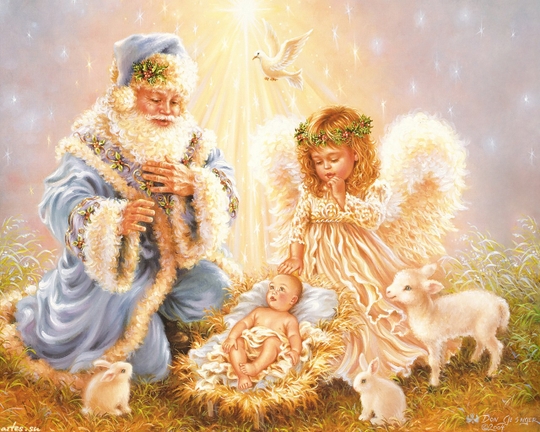
No, the most impressive addition to my understanding was that simple line, "with the help and kind ministrations of women fellow travelers."
It wasn't just the pair of them, all alone in some filthy barn in the middle of nowhere.
There were fellow travelers because they were right by a crowded inn! The inn was booked because the crowds came there to pay taxes for the same reason Joseph and Mary were there! People today might not realize how the stables would be "in town" like a parking garage would be nearby a hotel.
And it wasn't like some places today, people looking down their noses and ignoring the obviously quite-pregnant poor woman as she went into labor. Of course the women helped out, as women would! It was probably more likely they said, "Joseph! You go stand around with the menfolk. Fetch some water. Or towels. Just get out of the way!"
I've wondered whether this revelation of "women fellow travelers" was something that anyone had ever thought of. Has any Urantia revelation student, such as source-researcher Matthew Block, run across some such reference, I wonder? I mean, it's so glaringly obvious once you are told about it, did that idea really never occur to any mortal before the Urantia papers? We needed a super-human revelation to help us figure this out? Revelation? Mega-Duh with a V-8™ forehead slap!

•
•
•
•
•