
Primary tabs
Urantiana
Posts
Urantiana webworks in full, latest on top
Page 5 of 13, posts 21 - 25 of 63

With God all things are not necessarily going to happen, but are possible.
All that is necessary to break the spell of inertia and frustration is this: Act as if it were impossible to fail. That is the talisman, the formula, the command of right-about-face which turns us from failure towards success. --Dorothea Brande (1893-1948)
P.291 - §3 (26:5.3) That, then, is the primary or elementary course which confronts the faith-tested and much-traveled pilgrims of space. But long before reaching Havona, these ascendant children of time have learned to feast upon uncertainty, to fatten upon disappointment, to enthuse over apparent defeat, to invigorate in the presence of difficulties, to exhibit indomitable courage in the face of immensity, and to exercise unconquerable faith when confronted with the challenge of the inexplicable. Long since, the battle cry of these pilgrims became: "In liaison with God, nothing — absolutely nothing — is impossible."
P.555 - §3 (48:6.24) If you fail, will you rise indomitably to try anew? If you succeed, will you maintain a well-balanced poise--a stabilized and spiritualized attitude--throughout every effort in the long struggle to break the fetters of material inertia, to attain the freedom of spirit existence?
Tom's Compare 2011 August 18.
My dear old friend Tom has for several years been posting pairings of quotes from mortals with quotes from the Urantia Papers.
Tom's Compares at the Urantia Book Society of Oklahoma
My dear old friend Tom has for several years been posting pairings of quotes from mortals with quotes from the Urantia Papers.
Tom's Compares at the Urantia Book Society of Oklahoma
Act as if it were impossible to fail.
Tom has probably done more "compares" with those quotes "feast upon uncertainty" and "rise indomitably" than any other, or else I'm just more aware of them. A quick search of my "Compare" log (which goes back further than the online collection) shows he has used the "feast upon uncertainty" quote 15 times and "rise indomitably" 16 times. He has often paired them as above.
In 1995, I published UB Comix issue #6 on "Success and Achievement." One of the weakest issues, I always thought. I was trying to do the comix on a schedule at that time. I don't generally work well under a forced deadline, and I thought it looked forced. As the center page of that issue portrays. Always liked the back page, though.
Anyway, I often toyed with the idea of doing a second issue on that important subject. For research purposes on the subject. Or an article. Or something. I've copied several relevant "Compares" into a separate folder. The folder keeps growing. Here are some of Tom's Compare quotes from that folder:
"One of the secrets of life is to make stepping stones out of stumbling blocks." --Jack Penn (1909-1996)
"The key is to have a dream that inspires us to go beyond our limits." --Robert Kriegel (motivational speaker)
I like this one:
"How can they say my life is not a success? Have I not for more than sixty years got enough to eat and escaped being eaten?" --Logan Pearsall Smith, essayist (1865-1946)
 I'm currently into two books, a chapter in one and the whole subject of another is on the same theme of pushing one's boundaries, not succumbing to failure, and all that. I've heard this kind of motivational stimulus all my life, in and out of the UB, and yet, I've not really known what the UB in one place refers to as "the sweetness of goal attainment," more than very limitedly and very transiently. My fascination with success and achievement may therefore be somewhat comparable to a paraplegic studying great athletes or mountain climbers — a fascination with that which seems ever beyond my grasp.
Similarly, there's the exhortation to proceed "by decisions, by more decisions, and by more decisions." It's rightly been said, not to decide is to decide. Or, another way of saying it, if you don't decide, things will be decided for you. I haven't always been all that dynamic in marching toward choosing and deciding situations, but choices and decisions aplenty have been thrust upon me; I'd like to think I face decisions rather than run from them. I do my best to choose wisely. But best isn't always good enough, in the mortal sphere.
The fruits of my choosing have been pretty consistently rotten. There ought to be some taste of success somewhere in there. I've not got a lot of emotional energy to be depressed because I'm busy being so surprised at how consistently failure marks all my efforts. Since I try big things, naturally I have big failures with big consequences. I'd gladly rise indomitably and all that if it weren't that every time I rise I get smacked down harder, and it makes me wonder if I'm not trying things in all the wrong ways. Too much like Einstein's definition of insanity.
It's one thing to push the envelope in a worthy purpose, win or lose, and it's another to just be nuts. I'm afraid my choices fall more toward the nuts end than the wise. I don't hear the "still small voice whispering 'this is the way,'" so I guess and tend to guess badly. (This is why I don't gamble.) It may be true that "wise planning [is]... the one thing essential to worldly prosperity" (Rodan of Alexandria), but if "The best-laid schemes o' mice an' men gang aft agley, an' lea'e us nought but grief an' pain, for promis'd joy" (To a Mouse, on Turning Her Up in Her Nest with the Plough, by Robert Burns,) how much more true of the less-well-laid plans! When I think I've made plans, it often turns out I was just proceeding in a kind of hopeful pipe-dream.

For each argument that might be made, "Yeah, Don, but you [good thing]," I have seen too harshly the harsh negative consequences. And oddly enough, considering this is what I see, I'm really more optimistic than otherwise. That may be part of the reason why I don't plan well enough for the eventualities of failure, even though they are far more frequent than success.
A relative, not a Urantia Book fan, has sought after more-or-less bogus gurus and been into astrology and yoga, but he was nonetheless always an inspiration to me for seeking spiritual truth. So it was sad, in a way, to hear him tell me once that he himself was disheartened when he looked in an astrological tome about the influence of Pluto on his natal chart and it said, "This person will seek for the golden thread which runs through all the world's religions." It was not like he thought this was a good thing. It's not like there really was such a golden thread, or that there was truth, or that his seeking it was a good thing. It was disappointing because it was merely "in his stars." Like the color of your hair or eyes is in your genes, it doesn't really mean anything. I feel somewhat the same when I read about the influence of birth order. Fourth-borns like me "may have huge plans that never work out" and are "financially irresponsible.". Big plans that never work out and a lack of financial responsibility which would make "wise planning" possible. It's just in my stars and genes. That's not real inspiring.
So, I don't even feel like, as Rodan put it, "each life failure yielded the culture of wisdom and spirit achievement." Maybe I'm just too dense to benefit, but sometimes it seems a fail is just a fail.

But when I set out to live a life of loving service, believing that the will of God can be done in any earthly occupation, and find that my occupations seem all ultimately to be of great disservice and in fact end up undermining that very ability to proceed through which service is possible, as well as wrecking those fundamentals of home and family, I have to wonder, is it live or is it Memorex, or I mean, is it just that I'm the bumbling fool (in a universe of infinite possibilities, somebody gets to be) or is God up to something greater, down the line. Which seems to keep being down the line. Further down the line all the time, in fact. By Occam's razor, bumbling fool seems the more likely possibility. Whenever I encounter that old bromide, "God doesn't make junk," I cringe at the naivete. Nice words aren't always true. But, I suppose, I can't help but "act as if it were impossible to fail," anyway.
Found elsewhere on the WWWeb:
Topical studies at TruthBook.com (Urantia related site):on Success and Failure, Defeat
Prayers for Success & Breakthroughs In Business at Mountain of Fire
"The secret of happiness is not doing what one likes to do but in liking what one has to do." -Sai Baba
Topical studies at TruthBook.com (Urantia related site):on Success and Failure, Defeat
Prayers for Success & Breakthroughs In Business at Mountain of Fire
"The secret of happiness is not doing what one likes to do but in liking what one has to do." -Sai Baba
•
•
•

•
•
One of the first rules about the world of hypertext: YOU DON'T CHANGE THE LINKS!
 When the Urantia Foundation re-did their online Urantia Book a while back, they CHANGED ALL THE LINKS. So, now, none of those carefully-laid-in links from Mindful Webworks works. Well, that's not quite true. Links which just go to the Papers' web pages proper work, at least the few I've tested, but not any of the internal links, which refer to specific sections or paragraphs. ARGH!
I tried to help them be digitally smart, as far back as the pre-Internet CompuServe days, and could tell they were being digitally dumb. The fellow, can't remember his name, who was then preparing their first "official" digital version of the UB was a nice guy, enthusiastic about the task and its technical minutiae in good old geek fashion, and was fun to talk with. I was encouraging the Foundation to have a presence on Religion Forum on CompuServe, and he agreed this was a good idea. (This was as the Foundation was functioning primarily from abject digitized fear, and was fiercely battling the bootlegged searchable digital version Kristen Maaherra circulated. Some in the Foundation seemed to be afraid that that little set of 5-inch floppy disks would somehow bring down the Foundation and disrupt the unity of the movement, which as it turned out became a self-fulfilling prophecy.) Talking with Martin Myers about the UB's digital presence, though, was like trying to light a fire underwater with soggy matches. In the rain. During Biblical Noah's flood.
Historic Timeline of Events in the Revelation Community 1981-1995:
1991 Urantia Foundation initiates legal action against Kristen Maaherra for creating and giving away an electronic index to The Urantia Book.
1992 Martin Myers dismissed as Trustee of Urantia Foundation
1991 Urantia Foundation initiates legal action against Kristen Maaherra for creating and giving away an electronic index to The Urantia Book.
1992 Martin Myers dismissed as Trustee of Urantia Foundation

After my visit to the Foundation and that disappointing -- almost scary -- encounter with Martin Myers, I prepared a page of artwork for UB Comix that took the poster from one of the Halloween horror flicks, probably Halloween 5: The Revenge of Michael Myers (1989), and basically substituted Martin for Michael. (I've never seen any of that series; I have no use for the terror, gore, and horror genre at all. It was purely inspired by the name and the reputation Martin had as the bad guy.) It wasn't a very effective piece, not funny, and rather mean-spirited, I suppose. Might've got me sued! I might have ended up not using it, but... I have all sorts of old UB Comix notes and scripts and sketches and I never throw any of them away, but all of that vanished without a trace! I swear the Midwayers took that finished artwork and all the work-up pieces of it right off my art table!
Of all the stupid moves the Foundation has made, changing the links has to be one of the stupidest. How long will it take me to re-work just the framed study version of UB Comix #7!!
One of the first rules about the world of hypertext: YOU DON'T CHANGE THE LINKS! Mindful Webworks has been on four different sites, including, finally, MindfulWebworks.com, and all the web page links still work, redirecting from its former homes on Sprynet, CableOne, and us75.com, to the current site. Actually, I found some people on a website, I think it was Korean, linked, not to the web pages proper, but directly to UB Comix graphics, which is a hyperlink no-no, and those links are broken. It would have been prohibitively difficult to redirect every single graphic, so those old links to graphics are and forever will remain broken, but all links to the old-site web pages forward to the current location of that page.
YOU DON'T BREAK THE LINKS! There's lots of news sites that don't understand this rule, and their old pages to which I linked years ago have been re-URL'd or removed. But newspapers are notorious for not understanding the web. This is why your newspaper is dying!
Unlike periodicals, the Urantia Foundation has one main text, and you'd think they would have learned YOU DON'T BREAK THE LINKS! Even more annoying, they've added what look like internal links [e.g. "(1772.1) 160:0.1"] where, when you hover over the "160:0:1," an underline appears as if it were a link, but it's not! You can't right-click and copy-link on any of those. Whoever re-designed their online book didn't make the links the current right way. They used the old method of using a link tag like <a name="U160_0_1">. The "name" parameter is available only on "a" tags (the basic hypertext link tag), and has long ago been deprecated in favor of the "id" parameter, which can be added to any HTML tag. It's technical, but it's significant for a major recent re-write. And there's yet some other, different reason why these links don't work as live links, because even deprecated, they should, but don't.
If you know how, you can reconstruct internal links to each paragraph. For example, that link to Paper 160, introductory section, paragraph 1, ends with "paper-160-rodan-alexandria#U160_0_1" -- you just add paper, section, paragraph numbers, e.g. "#U160_0_1" (note the leading "#U" and the underscores), to the end of the paper's URL to create most internal paragraph links. Linking to section headers, the last number is a zero. But that's not intuitive, and the average non-techie web user is not going to know how to do that.
It's so annoying. They not only changed all the links, they changed them badly in multiple ways.
I used to link only to the Foundation's book using the same logic that caused me to buy a Radio Shack computer in the Spring of 1979, instead of that odd-looking alternative named after a fruit: I figured the Radio Shack company was big, in good standing, would be around a long time, and therefore would be able to be available for service if I needed it and would be upgrade-friendly. Wrong! Radio Shack came out with the utterly different Model II and then the supposedly-similar Model III which was not backwardly-compatible with all the software developed for the original Model I, and in other ways blew their lead in home computing. Us non-fruity computeys mostly went on to the similar IBM/MS-DOS line, and eventually were stuck in Windows™. Similarly, I thought, the Foundation's book, being the old-guard and the official, will always be online, and reliably WILL ALWAYS HAVE THE LINKS. Wrong!
YOU DON'T CHANGE THE LINKS! ARRRGGGHH! I'd complain to the Foundation, but what would they do about it? They're not going to roll it back, or put in the old links as well as the new (which, if you must re-do the links would have been the way to go). The toothpaste is already out of the tube, the horse is out of the barn, the new version is paid for, and people are presumably linking to it now. It's too late! I just have to re-do practically every link to The Urantia Book I ever put on my web pages! First I need to figure out whether I still want to link to the stodgy, stumbling old Foundation, or to some other unreliable, unstable, likely-to-screw-me-around site. The Foundation has hyperlinks noting the various printed-version changes, which changes were not cool, but having them hyperlinked is supercool, and you can toggle their version to have Jesus words in red, which is meh. There may be for-some-reason better versions of the book online now than the Foundation's. But if the Foundation is unreliable, so is everybody else. I now TRUST NO ONE!
Okay, got that off my chest. Whew.
•
•
•
•
•

I wanted to write
a poem about
The Palace of Cymboyton
a poem about
The Palace of Cymboyton
But the only rhyme
I came up with was
Glucosamine and Chondroitin!
Related article on another site:
Behzad Sarmast's 2007 article on TruthBook, seeking the site of Cymboyton's Palace.
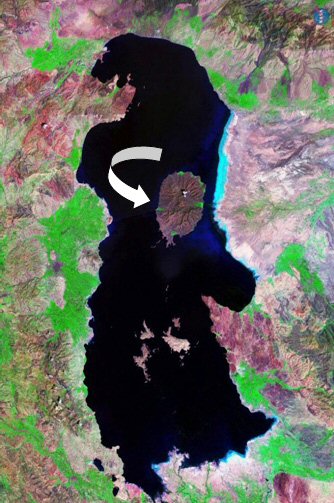
Lake Urmia, indicating the island of Sepeyton
Behzad Sarmast's 2007 article on TruthBook, seeking the site of Cymboyton's Palace.
Lake Urmia, indicating the island of Sepeyton
•
•
•
•
•
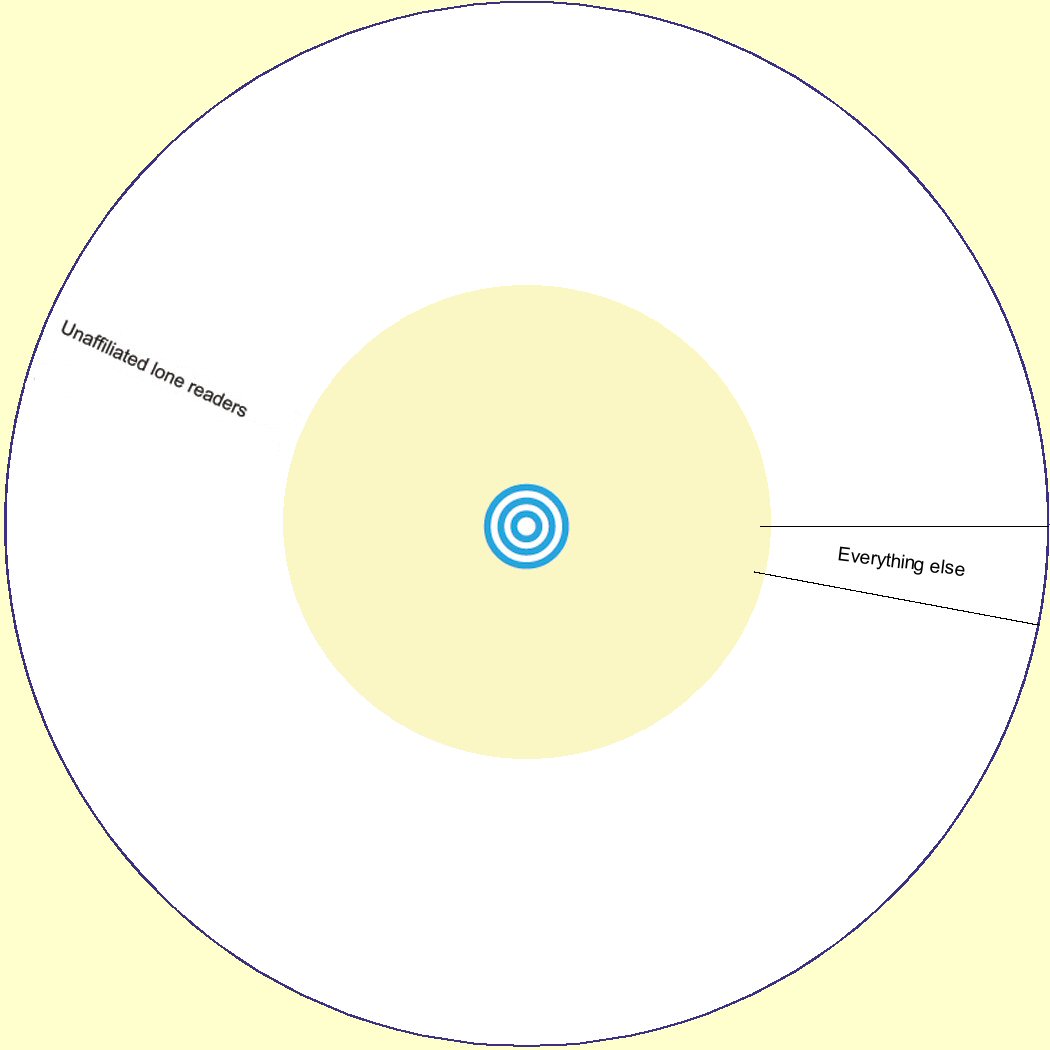
How
the
Urantia Moovement
is
viewed
from
within
the
Urantia Moovement
is
viewed
from
within

and
from
without
•
•
•
•
•
Artifacts upend theory on first North Americans
A cache of 15,500-year-old artifacts found buried in a Texas flood plain predates the well-known Clovis people, long thought to be the first inhabitants of the New World.
—Thomas H. Maugh II, Los Angeles Times

Stone tools 'demand new American story'
A number of digs across the Americas in recent decades had already hinted that the "Clovis first" model was in serious trouble.But the huge collection of well-dated tools excavated from a creek bed 60km (40 miles) northwest of Austin mean the theory is now dead, argue the Science authors.
"This is almost like a baseball bat to the side of the head of the archaeological community to wake up and say, 'hey, there are pre-Clovis people here, that we have to stop quibbling and we need to develop a new model for peopling of the Americas'," Michael Waters, a Texas A&M University anthropologist, told reporters.
—Paul Rincon and Jonathan Amos, BBC News
Dig solidifies evidence that first Americans were here 15,000 years ago
The newly unearthed objects come from a site northwest of Austin, which has been under excavation for several years along a waterway known as Buttermilk Creek. They consist of relatively crude scrapers, knife blades, broken and half-repaired spear points, and more than 15,000 flakes and chips testifying to human workmanship. They bear some similarity to Clovis tools, although not a clear one.Whether the people who made them were related to the people who made the Clovis tools is uncertain. However, no bones or other DNA-containing materials were found, so the question can’t be answered.
“Cultural history and biological history do not have to go hand in hand. So there’s no way you can say they were related to each other,” said Eske Willerslev, director of the Center for GeoGenetics at the University of Copenhagen.
—David Brown, Washinton Post
People Were Chipping Stone Tools in Texas More Than 15,000 Years Ago
The area where the tools were found, northwest of Austin, must have been an appealing campsite for millennia, because it bears a record of nearly continuous occupation from 15,500 years ago. The discovery is detailed in a new study, published online March 24 in Science.When the makers of these tools were using the site (from 15,500 to 13,200 years ago), the region would have been slightly cooler than it is today, probably by an average of about 5 to 6 degrees Celsius—"rather amiable at that time period," Lee Nordt, of Baylor University's Department of Geology and co-author of the new study, said in a press briefing on Wednesday. But the resources in the area were likely plentiful, added Michael Waters, of the Center for the Study of the First Americans at Texas A&M University in College Station and co-author of the new study. With the rich hill country around them, "it's not surprising people came back time and time again."
The people who left the tools and fragments described in the study were likely hunter–gatherers, passing through the site from time to time over thousands of years. "This was a mobile tool kit—something that was easily transported," Waters said.
Katherine Harmon, Scientific American
About eighty-five thousand years ago the comparatively pure remnants of the red race went en masse across to North America, and shortly thereafter the Bering land isthmus sank, thus isolating them.
—Urantia Paper 64, The Evolutionary Races of Color, §6. The Six Sangik Races of Urantia, ¶5 (pg 725)
Fifteen thousand, eighty-five thousand... still a pretty big gap. On the other hand, they apparently were pretty well-established deep in the heart of Texas by this point.
Similarly-themed articles in Urantiana:
Scientific Evidence of Space Respiration
Anthropology & The Urantia Book on hominid evolution
Humanity's Lemur-Like Asian Ancestry
Scientific Evidence of Space Respiration
Anthropology & The Urantia Book on hominid evolution
Humanity's Lemur-Like Asian Ancestry
•
•
•
•
•